Answers>Learn about wallets & identity>What is a crypto wallet?
What is a crypto wallet?
// Tags
crypto walletblockchain wallet
TL;DR: A crypto wallet is a tool that stores the cryptographic keys you need to interact with blockchain networks. Despite the name, a wallet does not actually hold cryptocurrency the way a physical wallet holds cash. Your assets exist on the blockchain itself. What the wallet stores is your private key, the secret piece of data that proves you own those assets and authorizes you to send, receive, and manage them. Without your private key, you cannot access your funds. Without proper key security, anyone who obtains your private key can take everything.
The Simple Explanation
Your cryptocurrency does not live inside your wallet app. It lives on the blockchain, recorded in a public ledger that anyone can view. What your wallet holds is the key to that record. Think of it like a safe deposit box at a bank. The valuables are in the box. Your wallet is the key that opens it. Lose the key, and the valuables are locked away forever. Let someone copy the key, and they can empty the box.
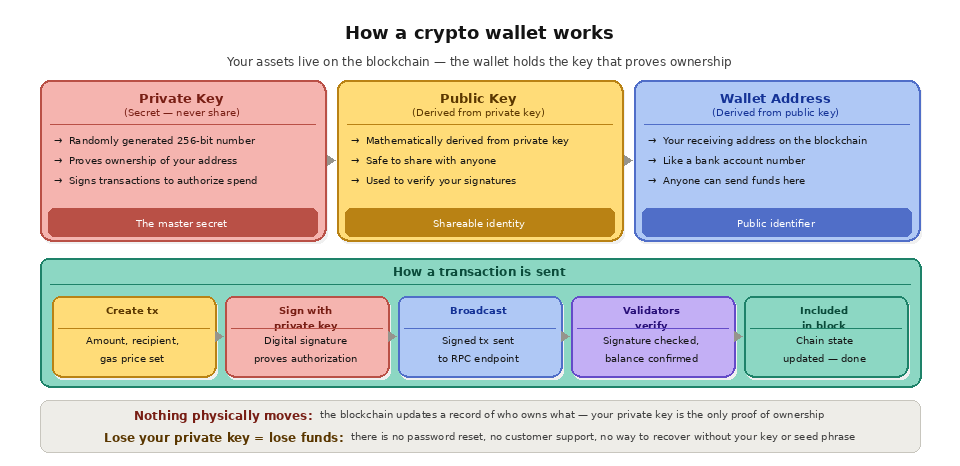
Every crypto wallet involves three core components. The private key is a randomly generated 256-bit number, essentially a very long password, that gives you complete control over the assets at your blockchain address. The public key is derived mathematically from the private key and can be shared freely. The wallet address is derived from the public key and serves as your receiving address, the equivalent of a bank account number that others use to send you funds.
When you "send" cryptocurrency, your wallet uses the private key to create a digital signature proving you authorized the transaction. This signed transaction is broadcast to the blockchain network, where validators verify the signature, confirm you have sufficient balance, and include the transaction in a block. At no point does anything physically "move." The blockchain simply updates its record of who owns what.
Types of Crypto Wallets
Wallets are categorized by how they store private keys and whether they maintain a connection to the internet.
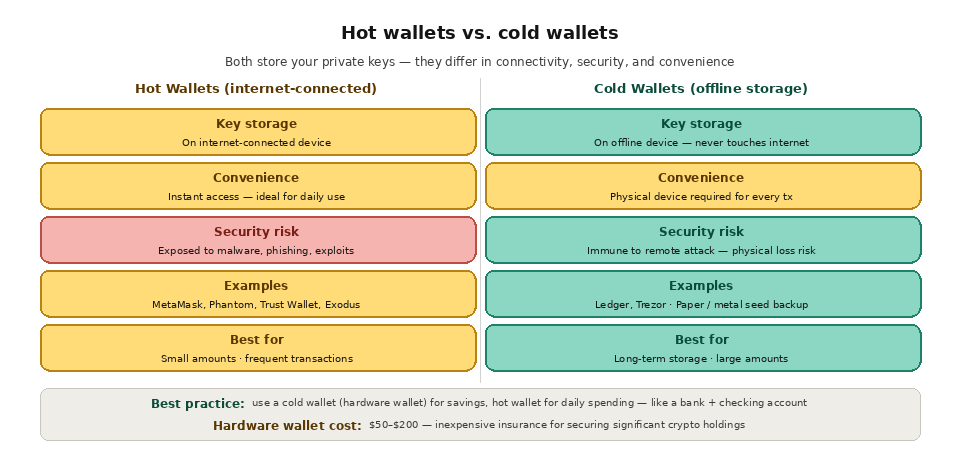
Hot wallets are software applications that store your private keys on an internet-connected device. They come in several forms. Browser extension wallets like MetaMask and Phantom run inside your web browser and enable direct interaction with decentralized applications. Mobile wallets like Trust Wallet and Coinbase Wallet run on your phone and are convenient for everyday transactions and QR code payments. Desktop wallets like Exodus run on your computer and offer a fuller-featured interface than browser extensions.
Hot wallets prioritize convenience and accessibility. You can send transactions, interact with DeFi protocols, and manage your portfolio in seconds. The tradeoff is security: because the private key exists on a device connected to the internet, it is exposed to a range of threats including malware, phishing attacks, browser vulnerabilities, and rogue browser extensions that can read and exfiltrate key data.
Cold wallets store private keys on devices that are never connected to the internet. Hardware wallets from manufacturers like Ledger and Trezor are the most common type. These are small physical devices that generate and store your private key in a secure chip. When you need to sign a transaction, the transaction data is sent to the hardware wallet (typically via USB or Bluetooth), you review and approve it on the device's screen, and the signed transaction is sent back to your computer or phone. The private key never leaves the device.
Cold wallets prioritize security over convenience. Because the key is stored offline, remote attackers cannot access it. You must physically possess the device and approve each transaction on its screen, which prevents unauthorized spending even if your computer is compromised. The tradeoff is usability: hardware wallets cost $50 to $200, require physical access for every transaction, and add an extra step to every interaction with a dapp. Paper wallets and metal backups are the most basic form of cold storage. They are simply the private key or seed phrase written down on paper or stamped into metal. They are immune to digital attacks but vulnerable to physical loss, damage, or theft.
Seed Phrases and Key Recovery
When you create a new wallet, you are given a seed phrase (also called a recovery phrase or mnemonic): a sequence of 12 or 24 common English words. This seed phrase is an encoded representation of the master private key from which all of your wallet's addresses are derived using a hierarchical deterministic (HD) key generation scheme defined by BIP-39 and BIP-44 standards.
The seed phrase is the ultimate backup for your wallet. If your phone is destroyed, your computer crashes, or your hardware wallet is lost, you can recover all of your addresses and funds by entering the seed phrase into any compatible wallet application. Every address your wallet ever generated, across any blockchain network, can be reconstructed from those 12 or 24 words.
This also means the seed phrase is the ultimate vulnerability. Anyone who obtains your seed phrase has complete and irrevocable access to every address and every asset in your wallet. There is no "forgot my password" flow. There is no customer support number to call. If someone else has your seed phrase, they can drain everything, and there is nothing you or anyone else can do to reverse it.
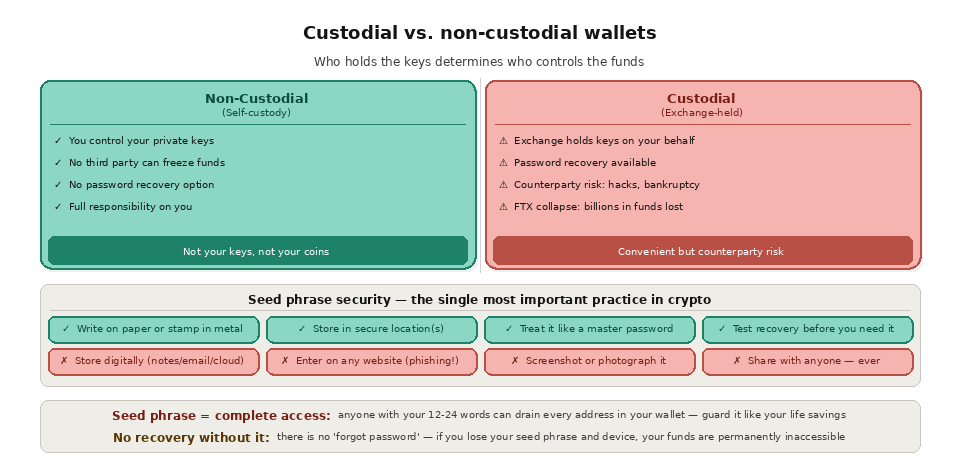
Proper seed phrase storage is the single most important security practice in crypto. Write it down on paper or stamp it into metal. Store it in a secure location (or multiple secure locations). Never store it digitally: not in a notes app, not in a screenshot, not in a cloud document, not in an email draft. Never enter it into any website or application unless you are actively recovering a wallet on a trusted device. Phishing attacks that trick users into entering their seed phrase on fake websites are among the most common causes of crypto theft.
Custodial vs Non-Custodial Wallets
A non-custodial wallet (also called a self-custody wallet) means you control the private keys. MetaMask, Phantom, Ledger, and Trust Wallet are all non-custodial. You generate the keys, you store the keys, and you are solely responsible for their security. No company can freeze your funds, block your transactions, or recover your keys if you lose them.
A custodial wallet means a third party (typically a centralized exchange like Coinbase or Binance) holds the private keys on your behalf. You access your funds through a traditional account with a username and password, and the exchange manages the keys behind the scenes. Custodial wallets offer familiar security features like password recovery, two-factor authentication, and customer support, but they introduce counterparty risk: if the exchange is hacked, goes bankrupt, or freezes accounts, you may lose access to your funds. The collapse of FTX in November 2022 demonstrated this risk, with billions in customer funds lost because the exchange controlled the keys. The crypto community's mantra, "not your keys, not your coins," reflects the strong preference for non-custodial wallets. Self-custody gives you absolute ownership and control, but it also places the full burden of security on you.
How Wallets Connect to the Blockchain
Behind every wallet operation, there is an RPC connection to a blockchain node. When your wallet displays your ETH balance, it is sending an RPC request to a node. When you submit a transaction, the wallet signs it locally with your private key and then broadcasts the signed transaction to the network through an RPC endpoint.
Most wallet applications ship with a default RPC endpoint, and many allow users to configure custom endpoints for better performance, privacy, or reliability. Professional users and teams often point their wallets at dedicated infrastructure like Quicknode endpoints to ensure fast, reliable access without depending on congested public RPC nodes.
What is the difference between a hot wallet and a cold wallet?
The split between hot and cold wallets comes down to whether the private key ever touches an internet-connected device. Hot wallets keep keys online for convenience, while cold wallets keep them offline for security. The table below compares the two.
Attribute
Hot wallet
Cold wallet
Internet connection
Always online
Offline
Convenience
High
Lower
Security
Exposed to malware and phishing
Keys never go online
Best for
Active trading and dapps
Long-term storage
Examples
MetaMask, Phantom
Ledger, Trezor
Cost
Free
$50 to $200
Many people use both: a hot wallet for daily activity and a cold wallet for savings. For a deeper comparison, see hot wallets vs cold wallets.
How do you choose the right crypto wallet?
The best wallet depends on how much you hold, how often you transact, and how much responsibility you want for security. The table below maps common wallet types to the situations they suit best.
Wallet type
Connection
Best for
Security
Browser extension
Hot (online)
DeFi and dapp use
Moderate
Mobile app
Hot (online)
Everyday payments
Moderate
Hardware wallet
Cold (offline)
Long-term holdings
High
Paper or metal backup
Cold (offline)
Deep cold storage
High if stored safely
Exchange (custodial)
Hot (online)
Beginners and active trading
Depends on the provider
Whatever you choose, the wallet is only an interface to the blockchain where your assets actually live. Matching the wallet to your risk tolerance matters more than picking any single brand.
How do you keep a crypto wallet secure?
Wallet security is mostly about protecting the seed phrase and the private key. Store the seed phrase offline, never type it into a website, and verify every transaction before signing. Hardware wallets add a strong layer because the key never leaves the device. Understanding how key management works is the foundation, and the right balance of hot and cold storage limits how much is ever exposed at once.
What is a smart contract wallet?
A smart contract wallet replaces the single private key with programmable logic deployed on-chain, enabling features like social recovery, spending limits, and gasless transactions. On Ethereum, this is powered by account abstraction. Because the wallet is a smart contract, it can enforce custom rules that a traditional key-pair wallet cannot. See account abstraction for how this model works and why it improves wallet usability and recovery.
Frequently Asked Questions
Does a crypto wallet actually store my coins?
No. Your coins exist as records on the blockchain. The wallet stores the private key that proves ownership and authorizes transactions. If you lose the key or seed phrase, you lose access to the assets even though they still exist on-chain.
What happens if I lose my seed phrase?
If you lose your seed phrase and no longer have access to the wallet device, the funds are unrecoverable. There is no password reset and no support line that can restore them. This is why the seed phrase should be backed up offline in more than one secure location.
Are hardware wallets worth it?
For meaningful balances, yes. A hardware wallet keeps the private key offline so remote attackers cannot reach it, and every transaction must be approved on the device. The one-time cost is small relative to the protection it provides for long-term holdings.
What is the difference between a wallet address and a private key?
The wallet address is derived from your public key and can be shared freely so people can send you funds. The private key is secret and must never be shared, because it authorizes spending from that address. Anyone with the private key controls the funds.
Can one wallet hold assets on multiple blockchains?
Yes. Most modern wallets derive addresses for many networks from a single seed phrase, so one backup can recover assets across Ethereum, Solana, and other chains. The wallet talks to each network through an RPC endpoint to read balances and broadcast transactions.
How Quicknode Fits In
Quicknode provides the RPC infrastructure that wallets and wallet-integrated applications depend on. When a wallet queries a balance, submits a transaction, or subscribes to new block events, it is communicating with a node through an RPC endpoint. Quicknode's Core API delivers this access across 80+ chains with globally distributed, low-latency endpoints and 99.99% uptime. For wallet developers building custom wallet solutions, Quicknode's enhanced APIs simplify common wallet operations like fetching token balances across multiple assets, retrieving transaction histories, and resolving ENS names, reducing the number of RPC calls required and improving the end-user experience.