Answers>Learn about RPC & APIs>What is RPC latency?
What is RPC latency?
// Tags
RPC latencyblockchain latencyAPI response time
TL;DR: RPC latency is the time it takes for your application to send a request to a blockchain node and receive a response. It is measured in milliseconds and directly impacts how fast your dapp feels to users. High latency means slow balance updates, delayed transaction confirmations, and missed trading opportunities. Low latency means a responsive, real-time experience. RPC latency depends on network distance, node performance, request complexity, and the quality of your infrastructure provider.
The Simple Explanation
Every time your application interacts with the blockchain, there is a delay between asking the question and getting the answer. That delay is latency. When a user opens your wallet app and waits half a second to see their balance, that wait is primarily RPC latency. When a trading bot sends a swap transaction and it takes 200 milliseconds to receive confirmation that the node accepted it, that 200ms is latency. The number might sound small, but in blockchain applications, especially DeFi, gaming, and trading, those milliseconds add up to real differences in user experience and financial outcomes.
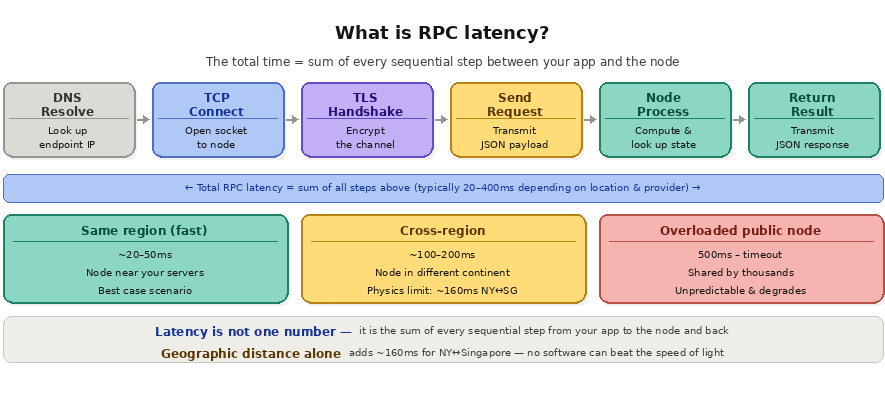
Latency is not a single number. It is the sum of multiple sequential steps: DNS resolution (looking up the endpoint's IP address), TCP connection establishment, TLS handshake (encrypting the connection), request transmission, node processing time, response transmission, and response parsing. Each step adds time. A request to a node in the same geographic region might complete in 20-50ms. A request to a node on the other side of the world might take 200-400ms. The same request to an overloaded or poorly maintained node might take seconds, or time out entirely.
Why Latency Matters More Than You Think
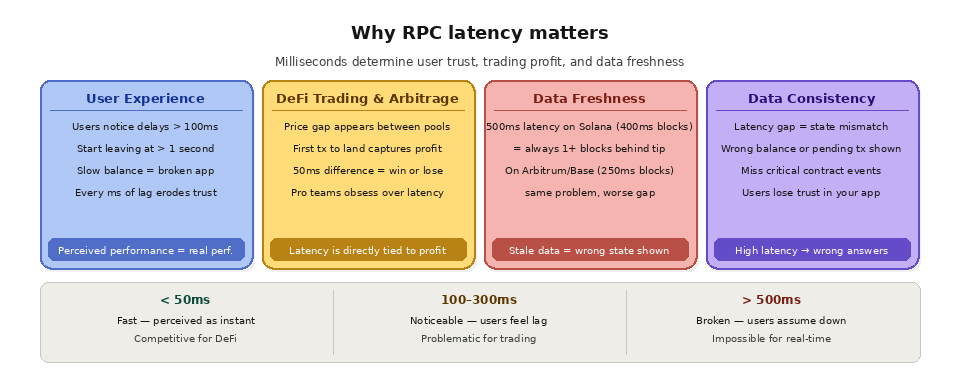
For user-facing applications, latency is the single biggest factor in perceived performance. Research across web applications consistently shows that users notice delays above 100ms and start abandoning interactions above 1 second. Blockchain applications are no different. If checking a balance takes two seconds because your RPC provider is slow, users will assume your app is broken, not that the infrastructure behind it is laggy.
For DeFi trading and arbitrage, latency is directly tied to profitability. When a price discrepancy appears between two liquidity pools, the first bot to land a transaction captures the profit. A difference of 50ms in RPC response time can determine whether your transaction gets included before a competitor's. This is why professional trading teams obsess over infrastructure latency and often use dedicated endpoints with geographic proximity to validators.
For data consistency, latency creates a gap between the actual state of the blockchain and what your application displays. On Solana, where blocks are produced every 400ms, an RPC provider with 500ms average latency means your application is always at least one block behind the chain tip. On Ethereum L2s like Arbitrum or Base, which produce blocks every 250ms, the same problem applies. Quicknode introduced a "Latency Freshness Score" metric that compares RPC response time to a chain's block production rate, giving developers a precise measure of how close to real-time their data actually is.
What Determines RPC Latency
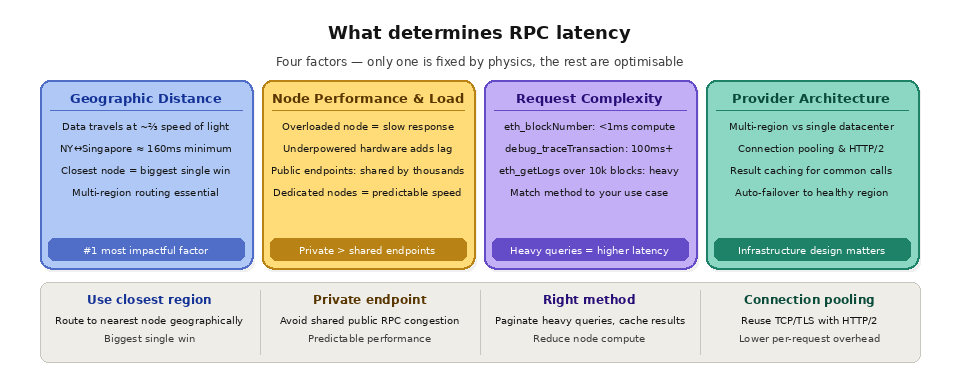
Geographic distance is the most fundamental factor. Data travels through fiber optic cables at roughly two-thirds the speed of light, which means a round trip between New York and Singapore adds approximately 160ms of pure physics that no software optimization can eliminate. Connecting to a node that is geographically close to your application servers (or your users) is the single most impactful thing you can do to reduce latency.
Node performance and load are the second factor. A node that is processing thousands of concurrent requests, falling behind on block sync, or running on underpowered hardware will respond slower than a well-provisioned, lightly loaded node. This is the fundamental problem with public RPC endpoints: they are shared by thousands of users, so their response times are unpredictable and degrade during traffic spikes.
Request complexity matters too. A simple "eth_blockNumber" call requires almost no computation and returns a tiny response. A "debug_traceTransaction" call requires the node to re-execute an entire transaction and return a detailed execution trace, which can take hundreds of milliseconds or more. An "eth_getLogs" query spanning thousands of blocks requires the node to scan significant amounts of data. Understanding the computational weight of your RPC calls helps you set appropriate expectations and optimize your request patterns.
Provider infrastructure architecture is the final factor. Providers that operate globally distributed node clusters with intelligent request routing, connection pooling, and result caching deliver lower and more consistent latency than providers running nodes in a single data center. Multi-region architectures also provide resilience: if one region experiences issues, traffic routes to the next closest healthy region automatically.
What is a good RPC latency?
A good latency target is relative to the chain you are serving and where your users are. The useful benchmark is not an absolute millisecond figure but how your response time compares to the chain's block production rate: if you respond slower than the chain produces blocks, your data is always at least one block stale. The table below gives practical targets for real-time responsiveness.
Context
Block time
Latency target for real-time
Solana
~400 ms slot
Under ~100 ms
Ethereum L2 (Base, Arbitrum)
~250 ms
Under ~100 ms
Ethereum L1
~12 seconds
Under ~250 ms
Same-region request
Not applicable
20 to 50 ms
Cross-globe request
Not applicable
200 to 400 ms
As a rule of thumb, users notice delays above 100 ms, so keeping typical RPC responses under that bar feels instant. To understand the calls behind these numbers, see how RPC requests work and the role of the RPC endpoint.
What is the difference between latency and throughput?
Latency and throughput are often confused, but they measure different things. Latency is how long a single request takes from send to response. Throughput is how many requests the system can handle per unit of time. A provider can have low latency but limited throughput, or high throughput but inconsistent latency under load. Both matter, and optimizing one does not automatically improve the other.
Aspect
Latency
Throughput
Measures
Time for one request
Requests handled per second
Unit
Milliseconds
Requests per second
Felt as
How responsive the app feels
How much load it can sustain
Hurt by
Distance and node load
Capacity limits and rate caps
For a fuller treatment of this tradeoff, see throughput vs latency. High request volume can also trigger RPC rate limiting, which adds retries and queueing that show up as higher effective latency.
How can you reduce RPC latency?
The biggest wins come from cutting distance and shedding load. Connect to a node geographically close to your users, use a multi-region provider with automatic routing, and reuse connections so you avoid repeated DNS, TCP, and TLS setup costs. Batch or simplify heavy calls, and replace tight polling loops with push-based delivery so you are not paying request latency repeatedly for the same data. Choosing streaming over polling, relying on reliable nodes, and having a failover path all keep latency low and consistent even when one route degrades.
Frequently Asked Questions
Is RPC latency the same as block confirmation time?
No. RPC latency is the round-trip time to query a node and get a response, measured in milliseconds. Block confirmation time is how long the chain takes to include and finalize a transaction, which is governed by the protocol. A fast RPC endpoint still cannot make a chain confirm blocks faster than its block time.
Why is my RPC endpoint slow?
The most common causes are geographic distance to the node, a heavily loaded or under-provisioned node, and expensive request types like trace or large log queries. Public endpoints shared by many users are especially prone to unpredictable, spiky latency during traffic surges.
Does latency affect DeFi trading?
Yes, directly. When an arbitrage opportunity appears, the first transaction to land captures the profit, so even a 50 ms edge in RPC response time can decide whether your transaction is included before a competitor's.
How is RPC latency measured?
It is the elapsed time from sending a request to receiving the response, summed across DNS resolution, connection setup, the TLS handshake, transmission, node processing, and response parsing. Teams usually track latency percentiles such as p50 and p99 rather than a single average.
Does low latency mean fresh data?
Not on its own. A fast endpoint that is behind on block sync can return stale results quickly. Real-time freshness requires both low latency and a node that is tightly synced to the chain tip, which is why response time should be compared to block production rate.
How Quicknode Delivers Low Latency
Quicknode's infrastructure is engineered specifically for low-latency blockchain data access. The platform operates a globally distributed network spanning 14+ regions across 5+ cloud and bare-metal providers, ensuring that requests are routed to the nearest available node regardless of where your application or users are located. This architecture delivers response times 2.5x faster than competitors on average, as measured by QuickLee, Quicknode's open-source RPC benchmarking tool that provides real-time, transparent latency data across multiple chains and regions.
Quicknode maintains high block-height recency across all supported chains, meaning its nodes are always tightly synced with the latest block. This is critical for fast-moving chains where falling even a few blocks behind the tip degrades data freshness. The infrastructure auto-scales based on traffic demand and includes automatic failover mechanisms, so latency remains consistent even during traffic spikes.
For applications with the most demanding latency requirements, Quicknode's Dedicated Clusters provide isolated, private infrastructure with no shared traffic from other customers. Dedicated Clusters eliminate the "noisy neighbor" problem entirely, delivering predictable, low-latency performance at all times. For Solana specifically, Quicknode's Yellowstone gRPC endpoints use Protocol Buffers instead of JSON for data serialization, reducing payload size and parse time for the lowest possible latency in high-frequency use cases.